
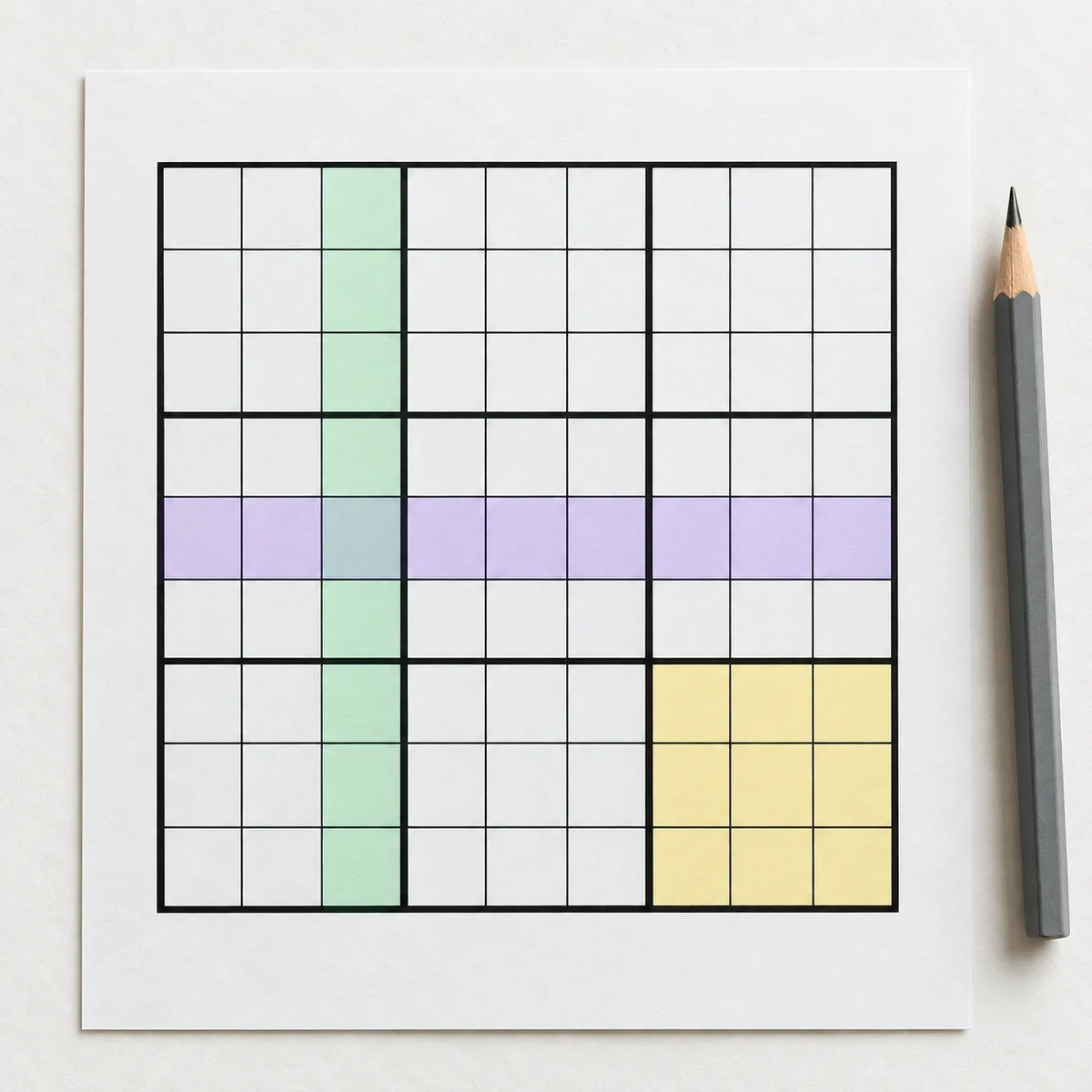
How to solve a hard sudoku without guessing
To learn how to solve a hard sudoku, start with a simple standard: every placement should have a reason. Scan digits 1 through 9 across rows, columns and boxes before reaching for an advanced pattern. Look for a naked single in a cell, then a hidden single where one digit has only one legal position in a unit. These moves may look small, but they change the candidates around them and often open the next step.
Do not treat a board with no obvious move as a board that demands a guess. If a deduction is not proven, keep it as a candidate and work elsewhere. A reliable pass has three actions: inspect a dense unit, update the affected candidates, and scan again. After each confirmed digit, return to its row, column and box. This rhythm prevents random clicking and gives you a clear place to review when something later contradicts.
The number of clues is only a rough difficulty signal. Two puzzles with a similar number of givens can need different ideas because the clues are arranged differently. Give yourself room to write and expect to revisit a unit several times. The useful pace is the one that leaves an audit trail: you can say which candidate was removed, by which constraint and at what point.
- Scan singles before searching for rare patterns.
- Write possibilities instead of placing a number by feel.
- Update the row, column and box after every placement.
- Keep the last certain fact as your recovery point.
Make a complete candidate pass
In a hard grid, candidates are your working map. For every empty cell, start with digits 1 through 9 and remove the digits already present in its row, column or box. The result is not an answer yet; it is the set of legal possibilities. Write it small and consistently. A stable notation makes pairs and patterns visible without recalculating the whole board.
Begin with cells in nearly complete units, then fill neighboring areas. When a digit is placed, remove that candidate from every cell in the same row, column and box. This update is as important as the first pencil-mark pass. A forgotten note can hide a single or create a false pair. If paper notes become messy, use a fresh copy or online note mode, but keep the same three-constraint check.
There are two kinds of singles. A naked single is a cell with one remaining candidate. A hidden single is a digit with only one possible position in a row, column or box even though that cell has several notes. Search for both after every pass; they connect basic rules to harder sudoku techniques.
- Remove a candidate only after checking all three units.
- Use one notation convention across the entire grid.
- Look for naked and hidden singles after every update.
- Erase stale notes as soon as a digit is confirmed.
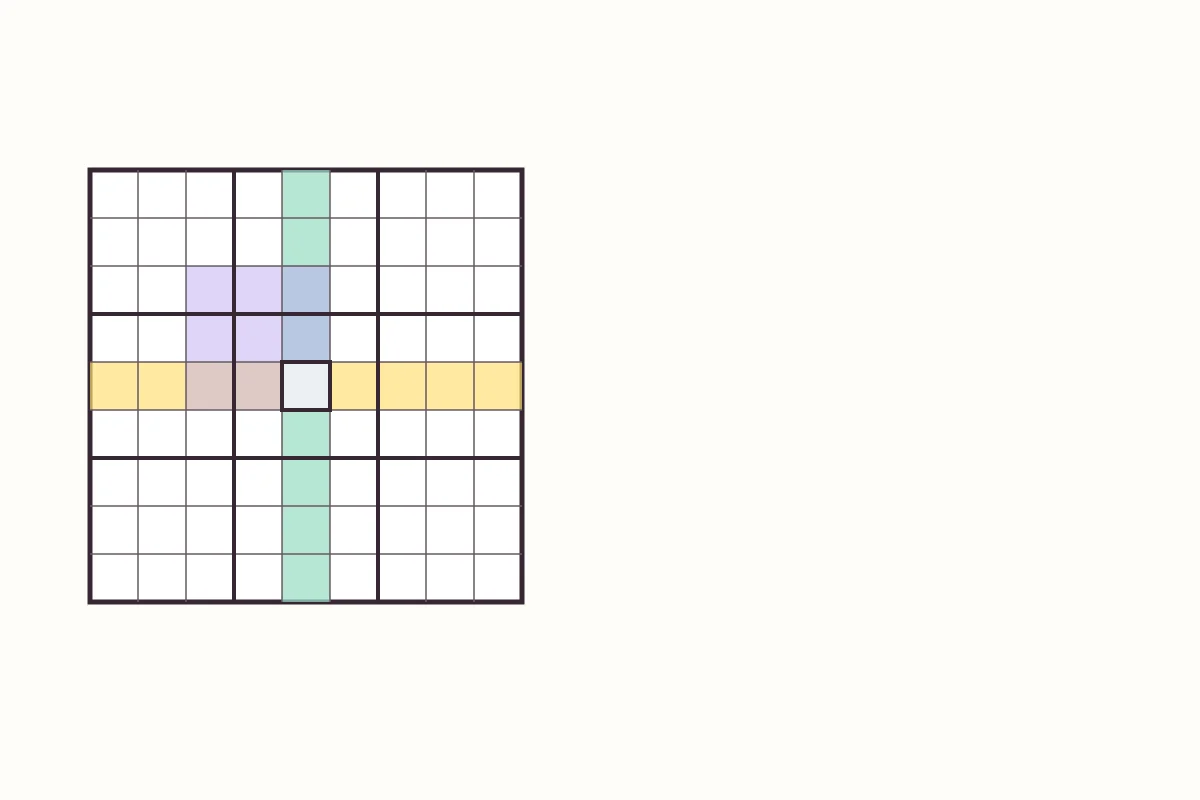
Move from singles to pairs and intersections
When singles stop moving the board, look for a naked pair. Two cells in one row, column or box form a naked pair when they contain exactly the same two candidates, such as 2 and 8. Those digits are reserved for those cells, so remove them from the other cells in that unit. A pair may not place a digit immediately, but it can reveal a single on the next pass.
Hidden pairs require the reverse view. In one unit, two digits may appear only in the same two cells even though those cells contain extra candidates. Keep the two digits and remove the extra notes. Confirm that both digits and both cells belong to the same unit. A pattern is useful only when it creates a real reduction that you could explain to another solver.
Pointing and claiming pairs use the connection between a box and a row or column. If every possible position for a digit inside a box lies on one row, remove that digit from the rest of the row outside the box. The reverse applies when all positions in a row fall inside one box. These intersections are often the next productive move in a hard sudoku.
- Naked pair: two cells share exactly two candidates.
- Hidden pair: two digits are restricted to the same two cells.
- Pointing pair: a box confines a digit to one row or column.
- Search for singles again after every elimination.
Use X-Wing and advanced patterns at the right time
Use X-Wing only after the candidate grid is complete and pairs or intersections no longer reduce it. For one chosen digit, find two rows where that digit appears as a candidate in exactly the same two columns. The four intersections are the corners of a rectangle. The digit must occupy two of those four cells across the two rows, so remove it from other cells in those columns outside the selected rows. Record each removal as a consequence, not a guess.
You can read the same pattern with rows and columns reversed. In very demanding puzzles, Swordfish extends the idea to three rows and columns, while an XY-Wing uses three bivalue cells to force an elimination. Choose a digit, confirm a clean candidate table and look for a precise reduction. If no legal removal follows, return to the checklist instead of forcing a shape.
Chains and coloring belong even later. They can show that a candidate leads to a contradiction, but they become hard to audit when notes are inconsistent. A practical order is singles, pairs, intersections, then X-Wing or a similar fish pattern. Each advanced move should simplify the next scan.
- Choose one candidate digit before looking for an X-Wing.
- Verify both rows and both columns before removing a note.
- Reserve Swordfish and chains for puzzles that truly require them.
- Drop a pattern that produces no verifiable elimination.
What to do when a hard grid is stuck
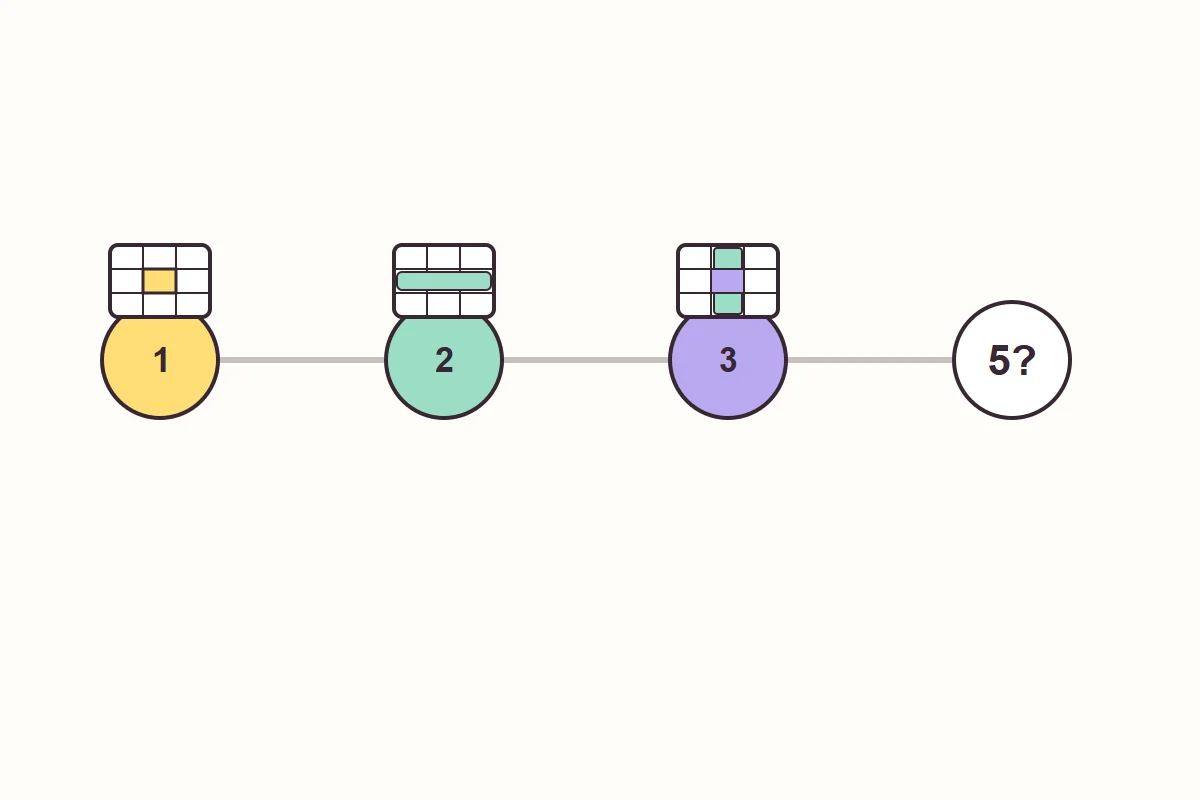
When you see no next move, do not switch randomly between techniques. Use a short checklist in the same order. First, check for duplicate digits in rows, columns and boxes. Second, rescan naked and hidden singles. Third, complete candidates in units that changed. Fourth, look for naked pairs, hidden pairs and intersections. This routine often exposes a stale note rather than a missing advanced technique.
If the board still does not move, choose a unit with few empty cells and compare the positions of one digit. Then make a targeted X-Wing search. Pause between passes; fast reading can blend a row with a neighboring box. On paper, a ruler or light highlight can help you follow a unit, but it should clarify constraints rather than replace deduction.
Finally, return to the last placement with a complete justification. If a contradiction appears, remove only the notes or digit added after that point. A correct puzzle does not become invalid because it is difficult; a contradiction usually means a note was missed, a pair was misread or an unmarked assumption slipped into the grid.
- Check legality before searching for an advanced pattern.
- Repeat singles, candidates, pairs and intersections in order.
- Choose one dense unit as the place to restart.
- Return to the last certain placement when a contradiction appears.
Avoid mistakes that erase your progress
The costliest mistake is placing a digit because it does not create an immediate duplicate. No conflict means only that the digit is a candidate; it does not prove the solution. Another common problem is keeping candidates without updating them. A pair or X-Wing built on an old note may look convincing while creating a false elimination.
Avoid mixing notation conventions. If a small digit sometimes means possible and sometimes means tested, the grid becomes impossible to review. Mark advanced assumptions in a separate area and never confuse them with certain placements. Explain each removal out loud: the digit, the unit and the reason. This habit catches shortcuts before they spread through the puzzle.
Time is not a quality score. A short pause to refresh candidates can save a long chain of errors. When learning with a printed puzzle, keep the answer separate and consult it only after recording your last certain point. The purpose of a method is to make the next useful step visible, not to finish at any cost.
- Do not treat a legal candidate as a confirmed solution.
- Update notes after every placed digit.
- Keep assumptions separate from logical deductions.
- Prefer a readable trail over speed.
Hard sudoku questions
Can a hard sudoku be solved without guessing?
Many hard grids can be solved by logical elimination. Fill candidates, find singles, use pairs and intersections, and move to an advanced pattern only when its result is checkable. An extreme puzzle may use a controlled assumption, but label it clearly.
What should I learn after singles?
Learn naked and hidden pairs first, then pointing or claiming pairs. They reduce candidates while keeping the same rules and prepare you for patterns such as X-Wing.
Why do my candidates produce no move?
Check for stale notes or a missed update after the last placement. Recalculate one dense row, column and box, then search for a hidden single. A notation error is more common than a missing technique.
When should I look for an X-Wing?
Look after singles, pairs and intersections when the candidate table is complete. Pick one digit and find two rows or columns with exactly the same two possible positions.
Does the number of givens define a hard sudoku?
No. The clue count is only a rough signal. Their arrangement and the techniques needed to progress matter more, so two grids with the same count can feel very different.
How do I recover after making a mistake?
Return to the last placement you can justify by its row, column and box. Remove digits or notes added after it, then repeat the checklist. Keep earlier deductions that still pass the three checks.
References and practice
These references show comparable technique progressions and provide a place to review logic before returning to a grid.